
You Read at the Speed You Learned Before You Were Nine.
That Ceiling Is a Habit. Habits Can Be Changed — and You Can Prove It to Yourself in Ten Days.
It costs forty-seven dollars, once. You own it for life. There is no subscription, no renewal, and nothing held back so you have to buy something else later. This page is long because I would rather answer every question you have now than sell you something you return in a week. Read as much of it as you need.
You are not a slow reader. You are a reader whose speed was set decades ago and never updated. The reading system you built between the ages of five and eight was exactly right for what you needed then. It got you through school. It has served you every day since. And it has been quietly limiting every book, report, and document you have read as an adult — without ever once announcing its presence. A ceiling does not advertise itself. You simply reach it and assume that is as high as things go.
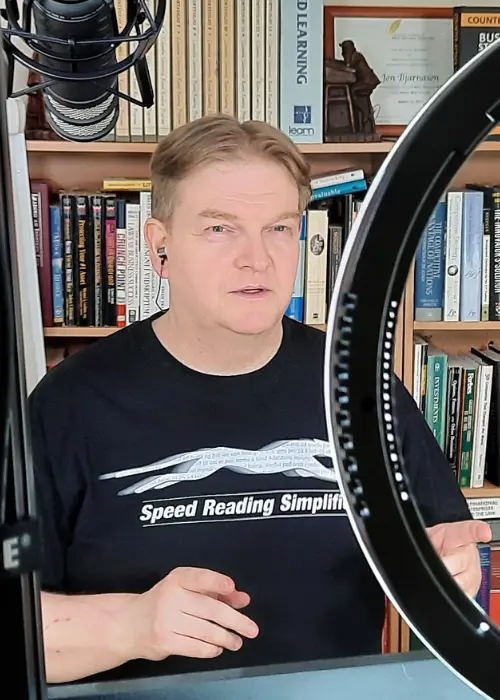
I am Jon Bjarnason. For twenty-one years I have taught one thing — how to read faster and enjoy reading more — and in that time I have worked with more than nineteen thousand students of every age and starting point, from seven-year-olds to a woman of ninety-four, in classrooms in Iceland and online around the world. The SRS Starter Kit is the first ten days of that work, put entirely into your hands. One structured exercise. Four to five short sessions a day. Ten days. A pencil and a book you already own. Most students feel the first measurable shift within two or three days.
In Brief
If you want the shape of it before the long argument, here it is.
What it is: A self-guided, text-based ten-day speed reading programme built around one simple exercise.
Who it is for: Any capable reader from roughly thirteen to ninety-plus who wants a permanently faster reading baseline — students, professionals, and lifelong readers alike.
What you do: One exercise, four to five short sessions a day, fifteen to thirty minutes in total, for ten days, with a pencil and a familiar book.
How it is measured: A baseline reading test before you begin and a re-test after the ten days — your speed and comprehension, in your own numbers.
Price: Forty-seven dollars, once. Yours for life. No subscription.
Guarantee: Practise for thirty days and if your reading speed has not at least doubled, a full refund.
The Question I Asked an Eleven-Year-Old Who Had Given Up on Reading
A few years ago an eleven-year-old boy came to one of my courses for children. I remember him because the first thing he did was walk up to me and apologise for being there. He told me he was terrible at reading and did not enjoy it, and that he was only there because his mother had made him come. Then he told me what he was good at: football. He loved football. He was, in his own estimation, fantastic at it.
He had tried other reading courses. Teachers at school had tried to help him. Nothing had worked. As far as he was concerned, reading was for the other kids. He had already closed the door on it, at eleven years old.
I took him aside and asked him one question. “If I told you, right now, at eleven, that you will never run faster than you do today — would you believe me?”
He did not need to think about it. “No,” he said. “I don’t believe you.”
“Really? How do you get faster?”
“You go out and run,” he said. “Every day. And you try to run a little faster and a little further each time. That’s how you improve.”
“And that,” I told him, “is exactly why your mother sent you here.”
I watched his face change as he understood it. The same thing that made him good at football — training, practised daily, with the intention of improving — was the thing that would make him good at reading. He had never once thought of reading as a trainable skill. He thought of it as a fixed fact about himself: I am bad at this. The moment that belief moved, everything else became possible.
I tell you this story first, before any of the science, because it is the whole programme in miniature. Almost everyone arrives carrying some version of that boy’s belief. “I’m just a slow reader.” “I’ve tried this before.” “It won’t work for me.” That belief is not a small thing. It is the ceiling. And the first job of this kit is not to teach you a technique — it is to let you prove to yourself, with your own eyes over ten days, that the ceiling was never fixed.
Why an Intelligent Adult Still Reads at a Child’s Speed
That story is not only a teaching device. There is hard cognitive science underneath it, and it is worth a minute of your time because it explains why so many capable, accomplished adults are stuck at a child’s reading speed without ever realising it.
In 1974, the researchers David LaBerge and Jay Samuels established that when a child learns to read, the physical work of decoding words has to become automatic — handed over to the unconscious — so that the conscious mind is freed to follow meaning. This automaticity is not a flaw. It is a biological necessity; you could not read this sentence without it. But it carries a hidden cost. The mechanics of your reading were placed on autopilot at around age eight, and autopilot does not improve on its own.
This is exactly where the football boy’s instinct about running was right. The performance researcher Anders Ericsson spent his career showing that once a skill becomes automatic and “good enough,” simply doing more of it produces no improvement at all — he called that naive practice. You do not become a faster runner by strolling to work for twenty years, and you do not become a faster reader by reading the news every morning for forty. Almost everyone can kick a ball. But kicking it in the park every weekend for two decades does not make you Lionel Messi. The gap between the weekend player and the elite athlete is not volume — it is deliberate, deconstructed practice aimed at the mechanics themselves.
That is the trap, and I call it the assumed skill problem. The skill locked into its childhood form. It works well enough that no one ever rebuilt it. And because you have no benchmark to measure it against, the ceiling stays invisible — your reading feels normal because it is normal, but normal is not the same as developed. The baseline test you take on the first day exists to make that invisible ceiling visible. The exercise exists to rebuild the mechanics, the way deliberate practice rebuilds any skill that has been left on autopilot too long.
Five Numbers That Explain Your Entire Reading Life
There are five numbers that, taken together, tell you where your reading speed is, why it is there, and how far it can move. None of them is a promise. Each of them is an explanation. Once you have seen them you cannot un-see them.
- 20 — the floor: Twenty words per minute is the lowest reading speed I have ever measured in a student: a sixteen-year-old boy, one word every three seconds, a single page of a novel taking him the better part of twenty minutes. Ten weeks later he was reading two hundred and twenty words per minute with better comprehension than when he began. I start here not because it is near your starting point — it almost certainly is not — but because it establishes the one fact that matters most: the range of what is possible is enormous, and the skill is trainable at every single point along it. No matter what your current speed is, if you are willing to do the work, your reading speed will improve.
- 150–180 — where most readers actually are: Across twenty-one years, the average silent reading speed of my incoming students has sat between one hundred and fifty and one hundred and eighty words per minute. Here is the observation that tends to land hardest. Have you ever sped an audiobook up to 1.25 because the narrator felt slow? Many listeners do. A professional narrator reads at roughly one hundred and fifty to one hundred and eighty words per minute — which means that if you read silently at that pace, you are moving through text no faster than someone reading it aloud to you. People speed up audio for plenty of reasons, but for a great many readers the brake is the same: an inner voice that still sounds out every word, a habit installed when you first learned to read aloud at six and never since removed.
- 240–300 — the upper edge of “normal”: This is roughly as fast as a capable adult gets without training, and only by dropping the movement of the lips and the whisper as you articulate the words with your mouth. It is the top of the unimproved range — and it is still less than half of what your eyes alone are physically capable of, as the next section will prove to you with arithmetic you can check yourself.
- 400 — the threshold where focus stops being a struggle: This is the most useful number on the page, and the reason you lose focus mid-page. Professor Nilli Lavie’s Perceptual Load Theory, developed at University College London, establishes a general principle: human attention has a fixed processing capacity, and when a task does not use all of it, the surplus does not rest — it automatically processes distraction. What I have watched across thousands of students is where that threshold tends to sit for reading: for most adults, somewhere around four hundred words a minute. Below it, reading is a low-load task, your spare capacity wanders, and you reach the bottom of a page having absorbed nothing. Push above it and there is little surplus left to wander with — and for many readers that is the first genuinely unbroken engagement with a page they have felt since childhood. The exact figure varies with the person, the text, and the day. The principle does not.
- 640 — proof your brain is nowhere near its limit: Steven Woodmore held the Guinness World Record for the fastest speech: six hundred and forty words per minute, forming every word aloud with his mouth. If a person can physically articulate words at that rate, the mind generating and tracking them is working faster still. The gap between the speed you read at and the speed your mind can actually work at is enormous, and closing it does not take a gift. It takes the exercise, daily practice, and a clear reason to read — and those last two are the only parts no kit can supply for you. They are also entirely within your control over the next ten days.
Your Eyes Are Not the Problem. The Rhythm Is.
Here is the single most reassuring fact in reading science. Through eye-tracking studies, the researchers George McConkie and Keith Rayner established that the eye does not glide smoothly across a line; it moves in jumps, pausing at points called fixations. At each pause it takes in a span of about eighteen to twenty characters — a few characters to the left of where it lands and most of them to the right — which is three to four ordinary English words in a single glance.
Read that again, because it changes everything. Your eyes can already capture three to four words at once. Not one word. Not letter by letter. Three to four words, every time they pause. You are not missing the hardware to read faster. You have had it your whole adult life.
So why do most adults crawl at a hundred and fifty to two hundred and forty words per minute? Two things together: how long the eye lingers at each pause, and the inner voice insisting on sounding out every word before the eye is allowed to move. The eye is ready to jump; the habit holds it in place. Now let us do the arithmetic together, because it answers the question every student asks in the first three days — can I really read this fast?
Take the lower figure: three words per fixation. A relaxed reader pauses about four times a second — that is two hundred and forty fixations per minute.
3 words per fixation × 240 fixations per minute = 720 words per minute
Seven hundred and twenty words per minute — using only the visual capacity you already have, at a relaxed pace, taking the lowest estimate. No new skill. No widened vision. The only thing between you and that number is the speed of the inner voice and the length of the pause — and those are precisely what the exercise retrains.
One honest qualification, because I will not oversell the arithmetic. That seven hundred and twenty is a demonstration of what your eyes can do at a relaxed pace on flowing text. Dense, unfamiliar, or technical material slows every reader down, and it should. The skill you are building is therefore not one fixed speed; it is the trained ceiling, plus the judgement to vary your pace with the material — which is exactly why the training works the way it does, as I will show you in a moment.
This is also where I will be honest in a way most of this industry will not. You have seen the advertisements promising twenty thousand words a minute, whole pages absorbed in a glance, a book in ten minutes. They are why so many people believe speed reading is a scam — and on those claims, they are right. The eye takes in three to four words per fixation, not a paragraph. The arithmetic that reaches seven hundred or a thousand words a minute is real and provable. The arithmetic that reaches twenty thousand is not arithmetic at all; it is skimming with a marketing budget. I am not going to sell you the fantasy. I am going to give you the real number, and the daily exercise that reaches it.
Why Training on a Novel Carries Over to Your Real Reading
If the reading that matters to you is contracts, reports, research, and textbooks, you may wonder why a speed reading programme starts you on a familiar novel. The answer is the same principle sprint coaches have used for decades, and it is the engine of the whole exercise.
When a sprinter trains with assistance that pulls them faster than they can run unaided — overspeed training — the nervous system is forced to fire faster to keep up. Remove the assistance and the adaptation remains; the athlete’s ordinary top speed has risen. Reading is a visual and motor skill, and it responds the same way. The exercise runs your eyes deliberately faster than your comfortable pace, and your system adapts to the load. That is also why the exercise feels harder than ordinary reading — the strain is the training, not a sign that something is wrong.
Familiar fiction is the right training ground for one precise reason: its easy vocabulary and flowing narrative give your nervous system a low-resistance environment to build raw mechanical speed, without being crushed at the same time by dense, unfamiliar ideas. You train the engine where the road is smooth.
And here is how it transfers, with a number you can hold onto. Your comfortable speed in dense non-fiction tends to settle at roughly half of your peak fiction training speed. So to read a complex report or an academic paper at four hundred words a minute — fast enough to stay fully engaged — you train your fiction speed past eight hundred. When you later pick up that difficult document without the pacer, your mind instinctively slows to absorb the harder material — but because your mechanical ceiling is now so much higher, that “slower” pace comfortably clears the speed you started at before training. You did not learn to skim your work. You raised the ceiling your work had been bumping against.
“But What About Comprehension?”
This is the objection that arrives for everyone, and it deserves a real answer rather than a reassurance. Here is the truth, including the part the “double your speed with no trade-off” advertising will never tell you, because it has already promised it away.
Nearly nine in ten of my students feel a wobble in comprehension in the first few days. It is so predictable that I built a hard rule into the opening week: for the first seven days, do not worry about comprehension. They worry anyway — of course they do. So let me be straight with you, because most of this industry will not be. Ten days is not enough time to teach comprehension in depth, and I am not going to pretend it is. What ten days does better than anything else is show you something most readers never get to prove to themselves: that much of what you have always taken for a comprehension problem is a speed problem wearing a disguise — and it begins to dissolve the moment speed gives your brain enough to stay engaged.
There is also a reason the wobble feels worse than it is. Robert Bjork’s research at UCLA on what he calls desirable difficulties shows that we are poor judges of our own comprehension in the moment — we mistake the easy, fluent feeling of slow reading for understanding, and we mistake the slight strain of faster reading for failure. In my own measurements the pattern is consistent: when a student feels they are following only sixty percent of what they read during the exercise, their tested comprehension is usually seventy to seventy-five. The discomfort is not the process breaking down. It is the process working. That is why I ask every student to keep going when comprehension feels uncertain — the friction is where the focus is.
But I do not ask you to take that on faith. I ask you to take the numbers. Every student takes a comprehension test before the exercise begins and another after the ten days are done. Across twenty-one years the same result repeats: roughly eight in ten finish reading faster with comprehension that is the same or higher — and they reached that without spending the first week working on comprehension at all. Speed and comprehension are not in tension. They are in sequence. Speed first, because until your brain is fully engaged, nothing you do for comprehension has room to work.
What about the minority? In a small number of cases, comprehension drops ten to thirty percent on the second test. Here is the part that matters. In almost every one of those cases the reader was, by then, reading two to four times faster than when they started. A ten to thirty percent dip while moving three times faster is not a loss. It is an option. Because now, in the time it once took you to read a difficult passage once, you can read it twice, three times, four times over — and a dense text read four times is understood far more deeply than the same text read slowly, once.
Think about the textbook that cost you a semester. Its author spent twenty years and more, learning what they compressed into those pages. Is it a defensible idea that reading it slowly, one time, gave you everything in it? Full comprehension of all the ideas. Of course not. The reader who can move through it four times in the time the single slow pass used to take has not skimmed it. He has studied it — four times over. That is what the speed actually buys. Not less comprehension. The time to comprehend more.
I call this the Starter Kit for a reason. Its ten days do the speed work in full, and they prove on your own pages that comprehension follows speed rather than fighting it — which is all most readers need to break the ceiling they walked in with. The deeper comprehension craft — holding questions in mind before you read and answering them in notes afterward, marking a text as you go, previewing before you begin — is a further ten days of training, which is why every full course I run lasts twenty-one days rather than ten. You are not being handed half a course. The kit gives you the genuine starting points toward that work, and from Day 12 the AI Teaching Assistant can help you begin it. What you are buying is the foundation the whole of reading skill stands on, built completely — and an honest account of what lies past it, for the day your own results make you want it.
What the SRS Starter Kit Actually Is
The Simple Speed Reading Exercise is the ten-day drill at the centre of this programme: a pencil-paced reading exercise, performed on a fiction book you already know well, that rebuilds your raw reading speed through overspeed training. You run it four to five short sessions a day, fifteen to thirty minutes in total, for ten days. It works by showing your brain — through your own direct experience, not through argument — that it is safe to move faster than your current habit allows. The speed was always available to you. The exercise removes the brake.
I am not going to pretend it is complicated, and I am not going to dress it up. It is simple enough to learn in a single sitting. Its power is not in any secret — there is no secret, and anyone selling you one is selling you nothing. Its power is in the daily repetition across ten days, the structure around it, and the fact that fiction you already know removes the comprehension pressure while you build raw speed. On Day 1 the kit walks you through the exercise itself, step by step, the first time. Each of the ten days has its own short training schedule and a set of Teacher’s Notes — the things I would say to you if I were standing beside you, written down in advance so that you never have to wonder whether you are doing it right.
Across the later days the kit introduces five short additional exercises — one-minute segments, each training a specific aspect of reading, introducing ways to start improving comprehension as you move past the first ten days, and ways to counter the inevitable plateaus in speed — so that by Day 10 you are not just faster, you are building the habits that make the speed permanent. Four Key Habit articles run alongside the exercise from the early days, because speed without the supporting habits fades, and speed with them compounds.
What Happens, Day by Day
So the structure is never a mystery, here is the whole arc. The programme is called a ten-day kit because the ten days are pure exercise — the testing sits on either side of them, so nothing eats into your training.
Day Zero — the day you buy. Welcome; the 4Q Reading Pulse Check (a version for ages 13–17 and one for 18+); your Baseline Reading Test (a timed read with ten comprehension questions, giving your starting words-per-minute and a comprehension score); the 20-question Reading Habits Self-Assessment; and the foundational reading, Unlocking the Benefits of Reading Faster. No exercise yet — this day sets your starting line.
Day 1 — a new morning opens. The four-step Simple Speed Reading Exercise, taught in full, with an on-screen minute timer and your daily log to download.
Days 2–10. A short Teacher’s Note each morning — the things I would say if I were beside you — and the four Key Habits woven in, each arriving on the day it lands hardest.
Day 11. Your re-test, on a different text in the identical format; your Day 11 results; the SRS Starter Kit Reading Diagnostic, which shows where your remaining friction sits and what to focus on next; and the closing 4Q Pulse Check.
Day 12 onward. Your evergreen version opens and the AI Teaching Assistant comes online, so you can keep training and ask questions whenever you need to.
One detail worth noticing: your Day Zero baseline and your Day 11 re-test use different texts of the same length and format. You cannot rehearse your way to a better number — the only thing that moves it is a genuine change in how you read.
Who This Is — and Who It Is Not — For
After twenty-one years and more than nineteen thousand students — busy entrepreneurs, bankers, lawyers, university and college students, lifelong fiction lovers, pensioners, children from seven to twelve — one truth has become impossible to ignore. They all begin in the same place, and they all need the same first thing: one exercise, and the knowledge that this simple exercise will move the needle wherever their starting point happens to be. This is that exercise, and this is that programme — a definitive guide to the first ten days, distilled from twenty-one years of working with readers of every age and every kind.
So who is it for? If you read — for work, for study, or for pleasure — and you have ever suspected you could read faster without losing what matters, it is for you. It does not matter whether you start at twenty words a minute or three hundred; the exercise meets you where you are.
Let me be equally clear about what it is not, because honesty about that is part of why you can trust the rest. It is not a comprehension course in itself — it does the speed work completely and gives you the starting points for comprehension, with the deeper craft being the next stage of training. It is not a medical or clinical intervention, and it is not a treatment for, or diagnosis of, any reading condition. And it is not a magic trick — it asks for ten days of small, real effort. If what you want is to absorb a book by flipping through it in ten minutes, I am not the teacher for you, and I have already told you honestly why no one is.
Everything You Are Probably Still Thinking
“I’ve tried speed reading before and it didn’t stick.”
Most speed reading products hand you a technique and hope you apply it. This one works in the opposite order. It begins by dismantling the beliefs that hold your speed in place — that slower means more careful, that your current speed is simply who you are — and it dismantles them not by argument but through your own daily experience. You felt the football boy’s realisation land a few minutes ago. The ten days are that realisation, made physical and repeated until it is yours.
“Isn’t this just skimming — skipping the unimportant words?”
No. Tell a lawyer reading a contract, or a student reading an exam text, to simply skip the words that look unimportant, and you will see the problem with that idea immediately. Speed reading is not about deciding which words to throw away. It is the beginning of a lifelong habit of reading sense — knowing where to accelerate and where to slow down, which words carry the meaning and which are already so familiar that your eye can move through them at full speed. Every word matters. But not every word needs the same handling. Some can be passed quickly because their meaning is already clear; some are grouped together for better comprehension. Taught correctly, speed reading gives you the judgement to vary your pace within a single chapter — and that judgement, not word-skipping, is the actual skill.
“Can’t I just use a reading app or run my finger down the page?”
The fact that anyone can call themselves a speed reader simply by using an app or a finger tells you how powerful the pacer alone is. But ask the obvious next question: is every text you read available inside an app? A printed contract, a paperback, a journal article, a child’s school book on the kitchen table — of course not. So would it not make more sense to build a real pacing habit that works on any reading material, anywhere, rather than one that depends on a particular screen? If you like the app, use the app. But a habit trained with a pencil works everywhere, and strengthening that one simple habit takes only a few sprints through this kit.
“Should I really be reading important things only once?”
For unimportant or merely entertaining text, once is plenty. For meaningful, important material, reading it a single time was never enough — you simply did not have the time to do otherwise. That is exactly what changes here. Once you read four or five times faster, re-reading a dense, important text three, four, even five times costs you what a single slow reading used to cost. The depth of understanding that produces is not something a one-time reader can reach. The speed does not replace careful reading. It makes genuinely careful reading affordable for the first time.
“What about ADHD, or dyslexia?”
Let me be careful here, because it matters: this is reading training, not therapy, diagnosis, or treatment, and it is not a substitute for the support a specialist provides. What it is, is the same exercise everyone else does — not a single step changes — and in my experience these are often the readers who gain the most, for reasons I explain honestly, and without overclaiming, in two bonus articles inside the kit. The sixteen-year-old who began at twenty words a minute was dyslexic. He did not stop being dyslexic. He became a dyslexic reader with trained eyes and a faster system, reading two hundred and twenty words a minute. The ceiling his dyslexia had imposed was not the ceiling he was stuck with.
“Am I too old? Does it work at my age?”
I have taught this to seven-year-olds and to a woman of ninety-four who came to my course because she still wanted to read more, and faster. The skill is trainable at every point in the range. Twenty, forty, sixty years of unchanged reading does not make you a worse reader; it makes you someone who has deeply automated the mechanics of a six-year-old. The exercise gives that system the targeted practice it has never once received, at whatever age you bring to it.
What Actually Happens to People Who Do the Work
I will not give you a words-per-minute promise, because your starting point is yours alone and an honest teacher does not pretend otherwise. What I can give you is what I have watched happen, repeatedly, for twenty-one years.
The sixteen-year-old who read twenty words a minute and reached two hundred and twenty in ten weeks. The thirteen-year-old who hated reading, who insisted she had no vocabulary — until I asked her whether she knew the words “the,” “but,” “in,” “for,” and “so,” and she raised her hands in surrender — and who three weeks later read three hundred words a minute. The ninety-four-year-old who simply was not finished with reading. None of them was exceptional. Each of them did the daily work.
And you will not have to take my word for your own progress either, because the kit gives you hard numbers on yourself. You take a reading comprehension test on Day Zero, before the exercise begins, and again on Day 11, once the ten days are complete. The gap between those two results is the thing this entire programme is built to produce — and a change you can measure is a change you can trust, which is the kind of change you keep.
What You Get, and What It Costs
Forty-seven dollars, paid once. You own it for life — no subscription, no renewal, no expiry. And it is designed to be run again and again: a fresh ten-day sprint whenever you want one, with the second sprint more valuable than the first because you begin it already trained. Inside the kit:
- The complete four-to-five-session-a-day Simple Speed Reading Exercise, with a daily training schedule and Teacher’s Notes for all ten days.
- Five additional one-minute exercise segments introduced across the later days, each targeting a specific aspect of reading development.
- Four Key Habit articles that build the foundation which makes your speed gains permanent rather than temporary.
- A reading comprehension test on Day Zero and again on Day 11 — bracketing the ten exercise days, so your progress is measured, not guessed.
- The SRS Starter Kit Reading Diagnostic, which opens on Day 11 once you finish your re-test, shows you where your remaining friction sits and gives you a personalised recommendation for what to do next.
- Two honest bonus articles on speed reading with ADHD and with dyslexia — direct, and without overclaiming — plus short practical guides for reading on a tablet or phone, for tackling textbooks, and for non-fiction.
The whole programme is text-based — built to be read at your own pace, on any device with a web browser — with short video timers for the exercises and tests, so a sixty-second segment is exactly sixty seconds. Access is immediate: the moment you buy, Day Zero opens, and each following morning the next day unlocks on schedule.
From Day 12, once the programme opens into its evergreen phase — where you begin adding the minute-segment variations and exercising your own judgement about your practice — an AI Teaching Assistant becomes available inside the course. It is included free, for life, in the price you have already paid. It knows the complete material and answers your questions immediately and privately: which exercise to use, which variation fits your situation, how to read your diagnostic result. It reliably helps with anything taught in the course; anything outside that scope, it flags as a question for me. And I — along with my team — can see those questions and step in directly where the assistant cannot. For the first eleven days you do not need it, because every structured day is explicitly instructed and nothing is left ambiguous. It arrives on Day 12, exactly when the instructions hand over to your own judgement.
Everything I add to the programme in future is yours as well, free, for as long as it exists.
That is the whole design principle, and I want it said plainly: nothing in the speed work has been held back so that you need to buy something else. The Starter Kit does the first and most important job — building a permanently faster reading baseline — completely, on its own, and it gives you the starting points and the in-course help to begin everything that follows. For the overwhelming majority of readers, that is the whole job. What comes after exists for the day you decide to go further — built on the success this kit gives you first, never on anything withheld from it.

The Guarantee
I can stand behind this with a strong guarantee for one reason: it works when you do the work, and the guarantee simply asks you to do the work.
The 30-Day Double-Your-Speed Guarantee
Let me be straight about why this asks for thirty days when the programme is built around ten. The ten days teach you the exercise and build the habit. But reliably doubling your reading speed, and keeping it, takes repetition past the first sprint — in my experience about three runs of the exercise, which is thirty days of practice. I would rather ask you to do the work that actually produces the result than promise you a number the first ten days alone cannot. So: do the exercise for thirty days, keep your daily log, run your re-test, and use the AI Teaching Assistant whenever you are unsure. If you do all of that and your reading speed has not at least doubled, email me, show me your log, and I refund every cent. No interrogation. Your log is all the proof I need.
The 12-Month Confidence Guarantee
If you run the full programme — baseline test, ten logged days of exercise, and a re-test — three separate times within your first year and still do not feel your reading has meaningfully improved, I refund you in full. The three runs need not be back to back; the evergreen version is yours for exactly this. Both guarantees ask you to do the work, because the work is the entire mechanism. The only risk you are taking is the time it takes to find out, and even that is protected.
SRS Starter Kit: The Definitive Guide to Your First 10 Days in Speed Reading - The full program for $47
-
Your SRS Starter Kit Evergreen Programme
1 lesson- This Programme Is Yours for Life
-
The SIMPLE Speed Reading EXERCISE
7 lessons- The Simple Speed Reading Exercise — Instructions Overview
- Step 1 - The SIMPLE Speed Reading EXERCISE.
- Step 2 - The SIMPLE Speed Reading EXERCISE.
- Step 3 - The SIMPLE Speed Reading EXERCISE.
- Step 4 - The SIMPLE Speed Reading EXERCISE.
- Your results - The SIMPLE Speed-Reading EXERCISE.
- SRS SIMPLE Exercise: Daily Exercise Results
-
Your 10-Day Daily Training Schedule
9 lesson- Day 2 — Your Teacher's Note
-
SRS Starter Kit: Day 3
- Day 3 — Your Teacher's Note
-
SRS Starter Kit: Day 4
- Day 4 — Your Teacher's Note
-
SRS Starter Kit: Day 5
- Day 5 — Your Teacher's Note
-
SRS Starter Kit: Day 6
- Day 6 — Your Teacher's Note
-
SRS Starter Kit: Day 7
- Day 7 — Your Teacher's Note
-
SRS Starter Kit: Day 8
- Day 8 — Your Teacher's Note
-
SRS Starter Kit: Day 9
- Day 9 — Your Teacher's Note
-
SRS Starter Kit: Day 10
- Day 10 — Your Teacher's Note
-
1 | Welcome — Start Here
1 lesson- Welcome — Here Is What Happens Before Day 1
-
2 | The 4Q Reading Pulse Check
2 lessons- Before We Begin — Ages 13 to 17
- Before We Begin — Age 18+
-
3 | Your Baseline Reading Test
4 lessons-
How Fast Do You Read Today? — Helen Keller (1593)
- Test — Helen Keller (1593) — on Paper
- Test — Helen Keller (1593) — on Screen
- Comprehension Quiz — Helen Keller (1593)
- How Fast Did You Read? — Find Your WPM
-
-
4 | The 20Q Reading Habits Self-Assessment
2 lessons- The Reading Habits Self-Assessment — 20 Questions
- Understanding Your Results | The Reading Habits Quiz
-
5 | Unlocking the Benefits of Reading Faster
1 lesson- Unlocking the Benefits of Reading Faster
-
6 | Four Reading Habits of Highly Skilled Readers
4 lesson- Habit 5: Schedule Time Daily for Reading
-
SRS Starter Kit - Habit 1
- Habit 1: Read with a Purpose
-
SRS Starter Kit - Habit 2
- Habit 2: Maintain Control of Eye Movement
-
SRS Starter Kit - Habit 6
- Habit 6: Maintain Control of Concentration and Focus
-
7 | Day 11 — Your New Baseline
5 lessons-
Day 11 — Your Re-Test
- Day 11 — You Did It! Your Re-Test Is Ready.
- Test — William Ewart Gladstone (1899) — on Paper
- Test — William Ewart Gladstone (1899) — on Screen
- Comprehension Quiz — William Ewart Gladstone (1899)
- Your Day 11 Results — How Far Have You Come?
-
-
8 | SRS Starter Kit Reading Diagnostic
1 lesson- SRS Starter Kit Reading Diagnostic - Your next step
-
9 | The 4Q Reading Pulse Check
1 lesson- 4Q Reading Pulse — Thank you. This matters.
-
BONUS: Speed Reading - and things you might need to consider
10 lessons- Speed Reading and Dyslexia - My observations in teaching 19.000 students
- Speed Reading and ADHD - My observations in teaching 19.000 students
- 11 Simple Tips on How You Can Read a Lot More Novels & Fiction!
- 11 Simple Tips on How to Tackle Textbooks for College or University With More Focus and Comprehension - and Without Putting You to Sleep!
- 11 Simple Tips on How to Read Non-Fiction, Self-Help and Handbooks.
- 7 Simple Steps That Will Help You Read on a Tablet, eReader or Phone.
- The SRS Reading Metronome: How a Simple Free Tool Builds a Faster Reading Pace
- The SRS Countdown Timer: How a Free Timer Protects Your Reading Sessions and Makes Habit 5 Automatic
- The SRS Reading Time Calculator: How to See What Your New Reading Speed Actually Means in Books, Hours, and Days
- Why it works - The Research: The Science Behind the Speed Reading Simplified Methodology
Questions You Might Still Have
What exactly do I get, and how do I access it?
A self-guided course inside a secure online classroom you reach from any web browser. Access is immediate: the moment you buy, Day Zero opens, and each following morning the next day unlocks.
Is it videos, or reading?
It is text-based — written to be read at your own pace — with short video timers for the timed exercises and tests so that a sixty-second segment runs exactly sixty seconds.
What book do I need?
A novel you already know and enjoy; the familiarity is the whole point, because it removes the comprehension pressure while you build speed. Paper is ideal, since you pace with a pencil. An e-reader you can mark works too. Audiobooks do not work for this — it is an eye-and-hand exercise.
How much time does it take each day?
Fifteen to thirty minutes, split into four or five short sessions. Not one long sitting.
What if I miss a day, or I travel?
The programme waits for you and your access never expires — pick up where you left off. The thirty-day guarantee counts the days you actually practise, not the calendar days you happen to be free.
Does it work for reading on screens?
Yes. The habit you build works on paper, e-readers, and screens alike. You train it on paper first because pacing with a pencil is part of the method, and the kit includes a short guide for carrying it onto a tablet or phone.
Does it work in languages other than English?
Yes — and more completely than that question usually assumes. I have taught readers whose native language is Arabic, Chinese, Korean, Japanese, and more. Most came to advance their speed in English, but I start them in their own language for the first four or five days, using a novel where their vocabulary is strongest, before they move across to English around the fifth or sixth day. The reason matters: speed reading is not really about left-to-right or right-to-left, or the letters and symbols a language uses. It is about vocabulary — how quickly your eyes and brain respond to the images the words call up in your mind. Your brain can read any language you have a strong vocabulary in faster, and with better comprehension. The steps are the same, the exercise is the same, and the time it takes at the start is the same. The course materials are in English, but the skill you build is not bound to English.
What is the AI Teaching Assistant, exactly?
A private assistant inside the course, included free for the life of your access, that knows the whole programme and answers your questions from Day 12 onward. It helps with anything taught in the course and flags anything beyond that for me; I and my team can see those questions and step in where it cannot.
Is my data private?
Your tests, your diagnostic, and your daily logs are yours. Your reading results are not shared.
What happens after the ten days?
Your evergreen version stays open. Run a fresh sprint whenever you like — the second is more valuable than the first, because you begin it already trained.
“Yours for life” — what does that include?
For as long as the programme exists you keep your access, your downloads, and every future update, at no further cost.
How do I pay?
Checkout is secure and access is immediate, worldwide. You will see the payment options available to you at checkout.
Ten Days From Now
When you finish, you will either have a re-test number sitting beside the baseline you wrote down before you began — in your own handwriting, showing you exactly what changed — or you will be reading at the same speed you have read at since you were eight, wondering. The exercise is simple. The science is sound. The only variable left is whether you do it. Forty-seven dollars, once, yours for life.
— Jon Bjarnason, Founder of Speed Reading Simplified
Not ready to commit forty-seven dollars?
Then prove it to yourself first, for free. SRS Starter Kit: Day One — Open Access gives you a full first day in the programme — the baseline reading test, the foundational reading, and a one-minute speed reading exercise — free. Do it. Feel the first shift for yourself. Then decide.